This piece comes from someone I follow on Substack- The Way She Came. Her perspectives and insights are always worth the read. Please support indepen
This piece comes from someone I follow on Substack- The Way She Came. Her perspectives and insights are always worth the read. Please support independent media. It is where the courage is found these days.
The Weaponization of DARVO: How Society and the Justice System Punish Black Girls for Surviving
As a Black woman, a mental health nurse, and an independent researcher of Black femicide, I have spent years staring into the abyss of violence against Black women and girls. Femicide is brutal and ugly, but the truth must be told. Too often, the suffering of Black women and girls is considered “off-limits” or merely an aside in broader conversations about racial violence. But when we look at how society responds to the victimization of Black girls, particularly when they are targeted by predators, we see a chilling pattern of adultification, misogynoir, and the weaponization of DARVO (Deny, Attack, Reverse Victim and Offender) tactics.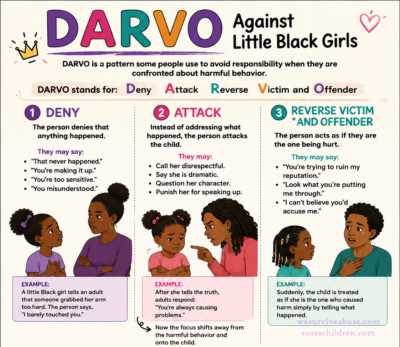
This pattern was starkly illuminated for me when I witnessed the public discourse surrounding the case of Kendra Scott, a 36-year-old Memphis mother who shot and killed a 20-year-old man she found hiding under her 13-year-old daughter’s bed. The online reaction, particularly from some indoctrinated Black women, was a masterclass in victim-blaming and internalized misogyny. Instead of recognizing a 13-year-old girl as a victim of grooming and statutory rape by an adult male, the discourse immediately shifted to slandering the child. Commenters argued that the girl “invited” him in, that she was “fast,” and that her mother’s strictness drove her to sneak a man into the house. The child’s innocence was entirely erased, replaced by a narrative that held her complicit in the crime committed against her.
This is the essence of DARVO. The perpetrator’s actions are minimized or denied, the victim is attacked for her perceived moral failings, and the roles are reversed so that the true victim is treated as the offender. When it comes to Black girls, this tactic is supercharged by historical adultification bias. The racist notion, dating back to slavery, that Black girls are less innocent, more adult-like, and more sexually knowledgeable than their white peers. They are viewed through the hypersexual lens of the “Jezebel” stereotype, making them targets for predators who know society will not protect them.
To understand the sheer hypocrisy of this response, we must compare the Kendra Scott case to that of Aaron Spencer, an Arkansas father. In October 2024, Spencer discovered his 14-year-old daughter was missing. He tracked her to a truck driven by 67-year-old Michael Fosler, a man who had previously been charged with grooming and sexually assaulting her. Spencer chased the truck for six miles, forced it off the road, and shot Fosler 15 times, pistol-whipping him for good measure.
How was Spencer treated by the justice system and the public? He was hailed as a hero protecting his child from a predator. The media rightfully described his daughter as being groomed, kidnapped, and raped. Spencer even ran for sheriff in Lonoke County on a platform arguing the system failed his family, won the Republican primary, and ultimately had his murder charges completely dismissed by a judge who cited “egregious” conduct by law enforcement for losing dashcam footage.
Aaron Spencer hunted down a man, chased him for miles, and executed him on the side of the road, and society rewarded him with political office and freedom. Kendra Scott found a grown man hiding in her 13-year-old child’s bedroom in the middle of the night, shot him, and is now facing first-degree murder charges with no bond.
Why is it justice in his case and not the mother’s? Sexism and racism, plain and simple.
Notice the way each case is described. The Black girl “invited” the deceased to her home, stripping her of the legal and moral reality that a 13-year-old cannot consent to a 20-year-old. The white girl, conversely, was described as being groomed and raped by the deceased. One’s sanctity is protected, while the other is held complicit in her own victimization.
This double standard extends beyond the courtroom and into our own communities. We must critically examine the “men as protectors” myth in light of child sexual assault, rape, and femicide. Men often allow other men culpability due to fear or complicity, leaving women to defend themselves and their children. Yet, when Black women take up arms to protect their daughters. When Black girls, like Cyntoia Brown, defend themselves against traffickers, they are criminalized, incarcerated, and villainized.
It is deeply disturbing to see Black women participate in this DARVO discourse online. By calling a 13-year-old victim “fast” or blaming her for the presence of a predator, we are doing the work of white supremacy and patriarchy. We are reinforcing the adultification bias that ensures Black girls are never seen as children worthy of protection. In the digital age, young Black girls are highly vulnerable to grooming by predators, and the unfathomable scrutiny they receive when victimized is a profound betrayal.
But the discourse has descended into something far more sinister than commentary. People—and I am sickened to say that many of them are Black—are actively sharing photographs and videos of this 13-year-old girl in compromising positions across social media platforms. A child. A minor. A victim. And her own community is circulating her images as though she is entertainment, as though her humiliation is evidence of her guilt, as though a child’s body is public property to be passed around in comment sections and group chats. I need to be unequivocal: this is child sexual abuse material. It does not matter that she is Black. It does not matter what the commentary says she did or did not do. Under federal law, the production, distribution, and possession of sexually explicit material involving a minor is a federal crime. If you have seen these images or videos, you are legally and morally obligated to report them to the National Center for Missing and Exploited Children’s CyberTipline at www.cybertipline.org, or directly to the FBI at tips.fbi.gov. Do not share them. Do not save them. Do not engage with them. Report them.
The fact that this child’s images are being weaponized and circulated is itself a form of sexual violence. It is a continuation of the assault that began the moment a 20-year-old man decided to groom and gain access to her. And the people sharing those images are not bystanders, they are participants in her abuse. This is what rape apology looks like in the digital age. It is not just dismissive commentary; it is active, coordinated harm. It is the community becoming the predator.
Black girls are not fair game. They never were. But the evidence before us suggests that too many people, including people who look like us, have decided otherwise. The circulation of a child’s compromising images while simultaneously arguing that her mother deserves prison is one of the most morally bankrupt positions I have ever witnessed. It reveals, with brutal clarity, that the goal was never justice. The goal was punishment. Punishment of the child for daring to exist as a Black girl in a world that has decided she doesn’t deserve protection, and punishment of the mother for daring to act as though her daughter’s life had value.
We must stop accepting the dismissal of race as a factor in these issues. We must recognize that the justice system will hand a white father a sheriff’s badge for doing what it will hand a Black mother a life sentence for. We must prioritize self-duty and the pursuit of our own freedom, unshackling ourselves from traditional narratives that demand our silent suffering.
It is time to dismantle the DARVO tactics used against Black girls. It is time to protect our daughters with the same ferocity that society protects white innocence. And it is time to demand that the justice system stop punishing Black women for surviving in a world that refuses to protect them.
Protecting Your Space Is Not Cruel. They Only Say That When Women and Girls Do It – Rosa’s Children
The Hidden Harmful Lessons We Are Teaching Girls Today – Rosa’s Children
Can We Talk About Girls? – Rosa’s Children
Revisting the Silencing of Silenced Women and Girls: R Kelly – WE Survive Abuse