Some people read news stories about what happens to abused and silenced girls and respond the way this beautiful gopher does as he watches his buddy g
Some people read news stories about what happens to abused and silenced girls and respond the way this beautiful gopher does as he watches his buddy getting his nails clipped. Very few will do anything about the pain they see. And by that I mean reflecting on what it means to stand by girls daily. To realize that we are nowhere near who we need to be when it comes to them and challenge ourselves to be better.
There is substantial research suggesting that girls’ pain is often misunderstood, minimized, or deprioritized in many settings. The hidden empathy gap is not just that girls hurt. It is that their pain keeps arriving in front of adults, systems, schools, courts, churches, clinics, and families, and too often the response is delay, doubt, discipline, or silence.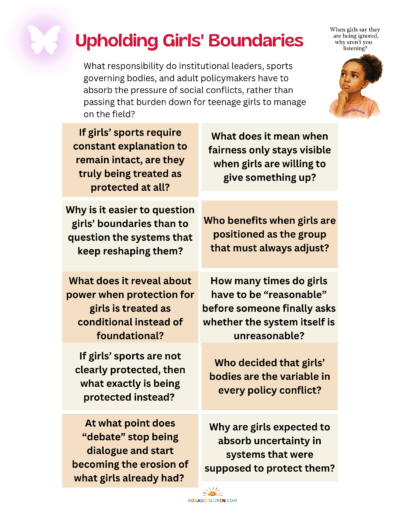
In medicine, girls and women have long reported that their pain is taken less seriously than that of males. Researchers have documented longer waits for pain treatment, greater likelihood that symptoms will be attributed to stress or emotion, and delays in diagnosis for conditions that primarily affect females. These patterns begin in adolescence, not only adulthood.
In 2023, 53% of U.S. female high school students reported persistent sadness or hopelessness, and 27% seriously considered attempting suicide.
In 2023, nearly 2 in 10 female high school students experienced sexual violence in the past year, and more than 1 in 10 had ever been physically forced to have sex.
Among female rape victims, about 42% experienced their first rape before age 18, according to NISVS data summarized by NSVRC.
RAINN reports that every nine minutes, a child in the U.S. is sexually assaulted, based on DOJ National Crime Victimization Survey data from 2020–2024.
In federal child maltreatment data for FY 2023, 546,159 children were found to be victims of abuse or neglect, and an estimated 2,000 children died from abuse or neglect.
For Black girls, the empathy gap has a name: adultification bias. Georgetown Law found that adults see Black girls ages 5–19 as needing less nurturing, protection, support, and comfort than white girls of the same age.
The U.S. Department of Education reported that Black girls were 7% of K–12 enrollment, but 9% of students receiving out-of-school suspensions and 8% of expulsions in 2020–21.
The GAO found in 2024 that Black girls faced more and harsher school discipline than other girls, including harsher punishment than white girls for similar infractions.
In health care, endometriosis diagnosis in the U.S. often takes 5 to 8 years, showing how girls’ and women’s pelvic pain can be normalized, delayed, or dismissed.
In criminal justice, girls who experience sexual abuse often encounter skepticism, delayed belief, or questions about their own behavior. Child protection experts have written extensively about how grooming, coercion, and trauma can make children’s disclosures fragmented or delayed, yet those very trauma responses are sometimes treated as reasons to doubt them.
In schools, girls who report harassment or assault may receive support, but many also describe being encouraged to preserve the school’s reputation, maintain peer harmony, or avoid “causing drama.” Research on institutional responses has found that organizational priorities can sometimes overshadow the needs of those reporting harm.
Psychologists have also studied what is known as the “justice motive” or “belief in a just world.” People often have a psychological tendency to assume bad things happen for a reason. When a girl is harmed, observers may unconsciously search for something she could have done differently because it preserves the comforting belief that the world is orderly and predictable.
Girls are also frequently socialized toward empathy, accommodation, and relationship maintenance. Adults may therefore expect them to absorb discomfort quietly. A girl who firmly protects her boundaries may be labeled “difficult,” while the same behavior from a boy may be interpreted as confidence or leadership. These expectations vary across families and communities, but the pattern has been documented by developmental psychologists.
For Black girls in the United States, researchers have identified an additional concern called adultification bias. Studies have found that Black girls are, on average, more likely to be perceived as older, less innocent, and more responsible for their own protection than white girls of the same age. This perception can reduce empathy and increase punitive responses. Work by Rebecca Epstein and colleagues at Georgetown Law Center on Poverty and Inequality brought national attention to this phenomenon.
Certain kinds of girls’ suffering consistently receive insufficient recognition. Examples include:
Chronic pain and reproductive health conditions.
Sexual abuse, especially when the accused is respected.
Psychological coercion and grooming.
Online exploitation.
Dating violence among teenagers.
The cumulative effects of repeated boundary violations.
The experiences of Black girls who are perceived as older and less vulnerable.
Many people feel sorry when they hear about a girl who has been harmed. Fewer are willing to change systems, accept inconvenience, or challenge powerful institutions to prevent the next girl from being harmed.
That difference helps explain why people can sincerely say, “We care about girls,” while girls continue to report feeling unseen. Concern expressed after harm is not the same as protection offered before harm.
Dear Girls: You Had Every Right to Speak – Rosa’s Children
Protecting Your Space Is Not Cruel. They Only Say That When Women and Girls Do It – Rosa’s Children
Can We Talk About Girls? – Rosa’s Children
Questions to Uphold Girls Boundaries in Sports – Rosa’s Children
Sources:
2020-21 Civil Rights Data Collection Student Discipline and School Climate in U.S. Public Schools
2023 Youth Risk Behavior Survey Results | Youth Risk Behavior Surveillance System (YRBSS) | CDC
Statistics In-Depth – National Sexual Violence Resource Center (NSVRC)
Statistics: Children & Teens – RAINN