The Ally’s Creed: "I am not here to be your peer; I am here to be your pillar. I will listen to your words, but I will also listen to your silence. My
The Ally’s Creed: “I am not here to be your peer; I am here to be your pillar. I will listen to your words, but I will also listen to your silence. My job is to ensure that when you look at yourself, you see a person worthy of protection, respect, and infinite love.”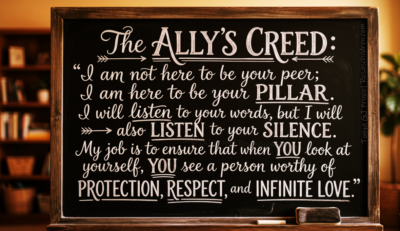
In our digital age, it is easy to mistake “relatability” for “advocacy.” We see adults learning the latest TikTok dances, adopting Gen Alpha slang, or memorizing the lore of the newest viral game just to feel “connected.”
Knowing the lingo isn’t the same as keeping the child safe.
In fact, being an “ally” to children has nothing to do with being cool. It’s about a steadfast commitment to their dignity, their safety, and their future.
The Predator’s Playbook: The Danger of “Relatability”
There is a chilling reality we must acknowledge: predators are often the most “relatable” adults in the room.
They study children with a clinical, predatory precision.
They don’t just learn the trends; they master the nuances, the quirks, and the specific interests of each new generation.
They use this knowledge to bridge the gap between “stranger” and “friend,” using the child’s own culture as a tool for grooming.
When we prioritize “being cool” or “fitting in” with a child’s world, we are playing on a field that predators have already mastered. True allies don’t just watch what children watch; they watch over children.
What Real Allegiance Looks Like
Being an ally to a child is a quiet, heavy, and beautiful responsibility. It is not a season that passes when the trends change. It is built on the following pillars:
Inviolate Safety: An ally creates an environment where a child’s physical and emotional boundaries are never up for negotiation.
Deep Listening: It’s not about knowing their slang; it’s about hearing the fear or the joy behind the words. It’s about being the person a child can talk to when the world feels loud and confusing.
Cultivating Self-Worth: A true ally mirrors back a child’s value until the child believes it themselves. You are the architect helping them build a foundation of self-love and self-respect.
Dignity as a Birthright: Children are often treated as “lesser than” because of their age. An ally treats a child with the same fundamental dignity and agency they would afford any human being.
The Steadfast Ally
While the “cool” adults are chasing the next trend, the ally is busy instilling values. Trends are fleeting; self-worth is permanent.
An ally is the one who:
Teaches boundaries instead of just “fitting in.”
Promotes joy that isn’t dependent on a screen or a “like.”
Protects fiercely, even when it makes them the “unpopular” adult in the room.
Predators study children to exploit them. Allies study children to empower them.
Being an ally means being the steady ground beneath a child’s feet. It’s about ensuring that when the trends of this generation fade away, the child is left with a core of iron—filled with the self-respect and dignity that no predator can ever take away.
The Anatomy of a True Ally
Prioritizing Safety Over Being “Liked”: An ally is willing to be the “unpopular” adult if it means keeping a child safe. They set firm boundaries and aren’t afraid to ask uncomfortable questions of other adults.
Active, Non-Judgmental Listening: It means creating safe space where a child can speak their truth without fear of being shamed, dismissed, or silenced…..or having what they told you manipulated and used against the child for adult gain or satisfaction.
Validation of Agency: An ally teaches a child that their body and their feelings belong to them. They reinforce the idea that a child has the right to say “no,” even to authority figures.
Consistency and Reliability: Children learn who to trust through patterns, not promises. An ally shows up, follows through, and remains a stable presence when the rest of their world is in flux.
Modeling Self-Respect: You cannot teach a child to love themselves if you treat yourself with contempt. An ally models healthy boundaries and self-care, showing the child what a dignifed life looks like.
Seeing the Individual, Not the Demographic: An ally studies the specific soul of the child—their unique fears, their specific brand of joy, and the quiet quirks that make them who they are.
Protecting Their Joy: In a world that rushes children to grow up or exposes them to premature burdens, an ally guards their right to play, to be curious, and to remain innocent for as long as possible.
Unconditional Positive Regard: An ally ensures the child knows their worth is not tied to their grades, their athletic performance, or their “usefulness.” Their value is inherent and unshakable.
Historical and Cultural Anchoring: An ally helps a child understand where they come from, giving them a sense of legacy and belonging that protects them from the “identity traps” of modern trends.
Fierce Accountability: An ally holds themselves and other adults to the highest standard of conduct. They are the first to speak up when they witness grooming behaviors or the crossing of boundaries.
The Ally’s Creed: “I am not here to be your peer; I am here to be your pillar. I will listen to your words, but I will also listen to your silence. My job is to ensure that when you look at yourself, you see a person worthy of protection, respect, and infinite love.”