Children learn from the way adults respond to discomfort. When a girl says, “I don’t like that,” and adults answer, “Maybe he was joking,” she learns
Children learn from the way adults respond to discomfort.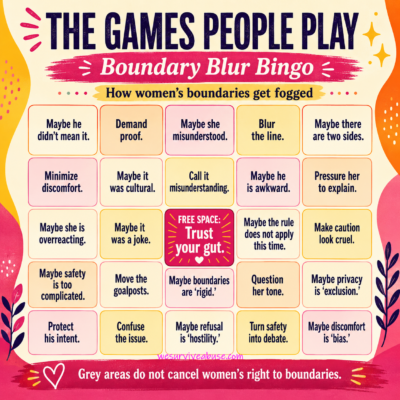
When a girl says, “I don’t like that,” and adults answer, “Maybe he was joking,” she learns that her discomfort is negotiable.
When a child says, “I don’t want to hug him,” and adults answer, “Don’t be rude,” the child learns that politeness matters more than body safety.
When a girl says, “Something feels wrong,” and adults answer, “You never know,” she may learn to distrust the very alarm system meant to help protect her.
We can do better.
Grey areas do exist. Misunderstandings happen. People can be awkward. But none of that means children should be trained to ignore discomfort, surrender boundaries, or stay silent to keep adults comfortable.
People who want safety for children come up with solutions. Potentially harmful people often dance around the grey zone, checking the boundaries in search of weak spots.
Affirmations for Children and Safe Adults
A child’s discomfort deserves attention.
A girl’s “no” is not a problem to solve.
Children do not have to prove danger before adults take them seriously.
Safe adults slow down.
Safe adults listen.
Safe adults protect first and investigate with care.
The games people play with women’s boundaries often begin in childhood.
So we teach something stronger:
Your body belongs to you.
Your voice matters.
Your discomfort is worth hearing.
And the adults around you should be wise enough to protect you, not clever enough to explain your warning signs away.