Wrong mom. Wrong kid. School secretly socially transitioned her daughter *chest binders included* and told her to keep secrets.She’s going to t
Wrong mom. Wrong kid.
School secretly socially transitioned her daughter *chest binders included* and told her to keep secrets.
She’s going to the Supreme Court.
This could be the case that finally draws a line:
Parents. Have. Rights. 🙏 pic.twitter.com/ZmITLejTKT— Jessica Rojas 🇺🇸💪 (@VoicesUnheard) January 7, 2026
 It wasn’t that long ago that I would have to be prepared to run up to the school during school hours to give my son a dose of “as needed” medication prescribed by his doctor. The school had the doctor’s note and the medication but they weren’t willing to make the call of what was considered “as needed.” I was both required to do that and happy to do that.
Things change fast, and sometimes when they do, we get it wrong.
As a mother and child abuse prevention educator, I strongly support this mother’s position. If it can impact a child’s health and well-being, a parent should be notified. ASAP.
We can’t have schools arbitrarily deciding to keep life altering secrets from parents. One of the first things we teach is adults do not keep secrets with children. Child abuse prevention educators emphasize that transparency between schools and parents is a fundamental safety barrier.
You know who is drawn to spaces where secrets between adults and children are commonplace? Predators. I think of cases like Deonte Carraway, who provided the students under his watch with cell phones so that he could keep in touch with them. Some time went by before the parents knew because it was a “secret”. In his book, Silent No More, Aaron Fisher talked about the secrets Jerry Sandusky forced him to keep right under the nose of his family.
The Critical Exception: The “Safety First” Protocol
The only time prevention educators advocate for withholding information from a parent is if the parent is the suspected abuser.
In these instances:
The educator is a Mandated Reporter and must contact Child Protective Services (CPS) or law enforcement immediately.
Educators are trained not to notify the parent before the authorities arrive. This prevents the parent from potentially “tipping off” others, harming the child, or destroying evidence.
The disclosure is then handled by trained forensic investigators rather than school staff.
This is an astute mom. Keeping secrets is burdensome and unhealthy for children. They may appear anxious, withdrawn, ill, irritable, or “heavy” when you ask about school. Perhaps the signs were there, and she picked up on them.
Aaron Fisher illustrates that so well in his book. You know how it all ends yet you feel like you are going through the funnel of the disclosure with him. It is heart shattering. See, whether a child is being abused by the adult secret keeper or not, the stress of carrying secrets -living in a home with their family, answering Mom’s questions dishonestly, pretending nothing is happening-for an adult to allow a child to carry that is unwise.
Adults have a responsibility to show children how to speak and live through hard things. How to come together as a family. How to go through the process. And I say this as someone who personally had to bring a treacherous secret to the family at the age of thirteen. Then went on to do it with families more times than I wish was necessary in my professional work.
Keeping secrets is a hell I wouldn’t wish on any child. You expend so much energy trying to make sure that the secret doesn’t slip out that you lose time you can’t get back.
I agree that not every parent or family is a good fit for homeschooling. And these days it is wearing on some of them. That’s what makes it even more important that we focus on making certain that boundaries and respect are prioritized in all schools.
Building the Circle of Protection
True protection for our children thrives in the light of transparency and mutual respect. As a parent, you are the primary architect of your child’s safety, and your right to be fully informed is the cornerstone of that foundation. When schools and families choose active collaboration over secrecy, they create a “circle of protection” that ensures every child feels seen, supported, and secure.
By honoring parental rights and fostering open dialogue, we do more than just follow a law—we build a village where children are empowered to grow, and where their safety is guarded by the strongest bond possible: the partnership between the home and the classroom.
I’m not certain that this is the same case or a different one but parents are fighting to assert their right to make the safest long term medical and health care decisions for their children. I have no idea how schools decided how they fit into the “co-parenting.” Who named them “co-parents?” Their job is to educate.
“John” and “Jane Poe” were never told their junior-high daughter was being treated as male at school for nearly a year. 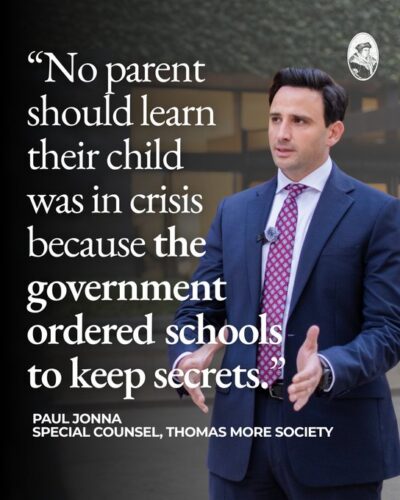 They only learned the truth after she attempted to take her own life. Unable to afford private school, they transferred her to another public school and expressly requested notice of her gender presentation and the use of her legal name and biological pronouns. Yet, to this day the school refuses to respect their request.
With the injunction in Mirabelli v. Bonta now stayed, the “Poes” remain in the dark about their own daughter. Today, Thomas More Society attorneys filed an emergency application with the U.S. Supreme Court requesting immediate intervention in Mirabelli v. Bonta.
| Action | Why it Works |
| Request the “Permanent File” | Under FERPA, you have the legal right to review all educational records. Look for “sole possession” notes that aren’t usually shared. |
| Ask Open-Ended Policy Questions | Instead of “Are you keeping secrets?”, ask: “What is the specific protocol for notifying parents if a child changes their nickname or behavior in class?” |
| Check District Policy Manuals | Many schools that keep secrets are doing so because of state laws or district mandates. Read the Parental Rights section of your district’s handbook. |
| Volunteer Unannounced | If the school makes it extremely difficult to volunteer or pop in, it may indicate they are controlling the environment too tightly. |
FERPA stands for the Family Educational Rights and Privacy Act. Enacted in 1974 (and often called the Buckley Amendment), it is a federal law that protects the privacy of student education records.
It applies to all schools that receive funds under an applicable program of the U.S. Department of Education—which includes virtually all public schools and school districts, as well as most private and public post-secondary institutions.
1. The Three Primary Rights
FERPA grants parents (and students who have reached age 18) three main rights:
The Right to Inspect: You have the right to review your child’s “education records” maintained by the school. Schools must comply with a request to inspect records within 45 days.
The Right to Seek Amendment: If you believe a record is inaccurate, misleading, or violates the student’s privacy, you can ask the school to change it. If the school refuses, you have the right to a formal hearing.
The Right to Consent: Schools generally cannot release “personally identifiable information” (PII) from a student’s record to third parties without your written consent.
What Counts as an “Education Record”?
FERPA covers more than just grades. It includes:
Transcripts and GPA.
Attendance records.
Disciplinary files.
Health and immunization records held by the school.
Schedules and placement information.