There are children who grow up in homes where danger has a pattern.It may not look dramatic every day. It may not announce itself with broken dish
There are children who grow up in homes where danger has a pattern.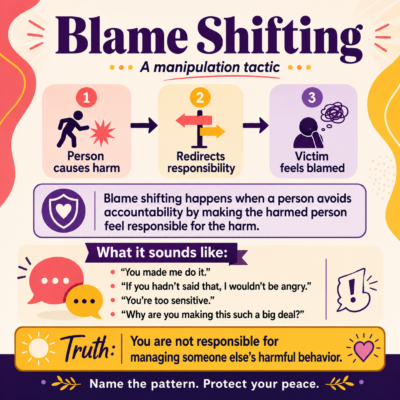
It may not look dramatic every day. It may not announce itself with broken dishes or police cars outside. Sometimes the danger sits at the dinner table. Sometimes it pays bills. Sometimes it smiles in public, sings in church, cracks jokes at family gatherings, and knows exactly how to become gentle when outsiders are watching.
But the child knows.
The child knows the shift in the air. The child knows when a voice changes by half an inch. The child knows which footsteps mean peace and which footsteps mean everybody better get quiet. The child knows when laughter is safe and when laughter is only a cover for something coming next.
Children in these homes become students of the room.
They learn to watch faces before they learn to trust words. They learn to measure moods before they learn to name feelings. They learn that some adults are not to be questioned, not because those adults are wise, but because those adults are dangerous.
This is part of why we say children are victims.
Not because children have no strength. Many children are brilliant in their survival. They notice what grown people miss. They protect siblings. They hide fear. They make plans. They become creative, alert, helpful, careful, and emotionally skilled far beyond their years.
But that is exactly the problem.
A child should not have to become an expert in adult instability.
A child should not have to study danger in order to survive home.
When adults shift blame onto children, they place a grown person’s burden on a child’s shoulders. The child may be told, directly or indirectly, “Do not upset him.” “Do not make her angry.” “Stop crying before you make it worse.” “Go apologize.” “Give him a hug.” “You know how she gets.” “Do not tell family business.” “Do not embarrass us.”
At first, the child may not understand this as blame-shifting. The child may simply believe, “I need to be better.” “I need to be quieter.” “I need to help more.” “I need to make sure nobody gets mad.”
That is how the trap begins.
The person causing harm remains the center of the household. Everybody else learns how to orbit around that person’s moods. The victimized parent may be blamed for not keeping peace. The child may be blamed for asking questions. The family may blame the truth-teller for “causing trouble,” while the person causing the fear is treated like an unavoidable force of nature.
This is what has been called “The Safety Transfer.”
“The Safety Transfer” happens when the person creating danger shifts the work of safety onto the people being harmed. The dangerous person keeps the power. The harmed person gets the assignment.
In a child’s world, this can become deeply confusing. The child may love the adult who frightens them. The adult may also provide food, shelter, affection, money, jokes, gifts, or moments of tenderness. Harm rarely arrives in a form simple enough for a child to sort through cleanly. Often, it comes mixed with loyalty, dependence, fear, family pride, religious language, cultural expectations, and the desperate wish that tomorrow will be better.
So the child adapts.
The child learns to keep the peace. The child learns to read the face. The child learns not to upset the dangerous person. The child learns to explain the unreasonable person to everyone else. The child learns to protect the family image. The child learns to absorb blame. The child learns to apologize first. The child learns to stay small so the storm passes.
Then adulthood comes.
But sometimes the old assignment comes too.
Some people do not leave that dynamic when childhood ends. They carry it like an invisible family rule. They may enter relationships, workplaces, churches, friendships, or community spaces where the same pattern repeats. Not because they are foolish. Not because they “like drama.” Often, their nervous system recognizes the old job before their conscious mind can name it.
They were trained to believe safety is something they earn by managing someone else.
This is why some adults stay too long in harmful relationships. This is why some people apologize when they have done nothing wrong. This is why some people feel guilty when they set a boundary. This is why some people shun and bully others who do set boundaries around violence and violence instead, choosing safety, joy, and peace. This is why some people mistake constant anxiety for love, over-functioning for loyalty, and silence for maturity.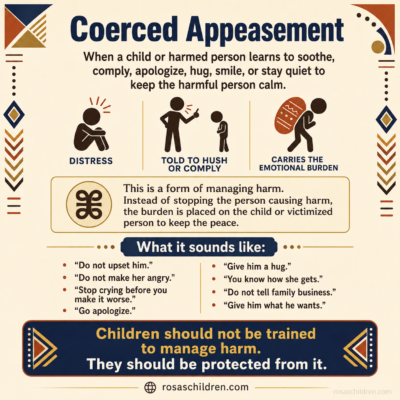
The body remembers the old house.
The spirit remembers the old rules.
And unless someone interrupts the pattern, the person may keep trying to survive a childhood assignment in an adult life.
That interruption matters.
It may come through counseling, advocacy, a support group, a wise elder, a book, a friend, a teacher, a pastor with discernment, a workplace that refuses to punish the harmed person, or a bounded space where the person is finally allowed to tell the truth without being corrected back into silence.
Intervention does not always look dramatic. Sometimes it is one sentence that lands at the right time: “That was not your responsibility.” Sometimes it is watching another family operate without fear. Sometimes it is seeing an adult apologize without punishing everyone for needing the apology. Sometimes it is realizing, slowly, that calm does not have to mean danger is gathering in the next room.
A person can become highly skilled at surviving a harmful system and still need help learning how to live outside of it.
That is not weakness.
That is re-education. That is reclamation. That is breaking the old contract.
There is another truth we have to hold carefully. Children raised in blame-shifting homes may grow up and land on different sides of the pattern. Some become the person who keeps trying to manage everyone else’s danger. Others become the person who expects everyone else to manage theirs. Some move between both patterns at different points in life.
This does not excuse abuse.
It explains how false lessons travel.
A child who watches one adult intimidate the whole household may learn that power means making other people adjust to your moods. Another child in the same home may learn that love means taking responsibility for someone else’s cruelty. One child may become the appeaser. Another may become the storm. Both were shaped by the same broken classroom.
But adulthood brings responsibility. Once a person is grown, the work changes. The victimized adult deserves support, safety, and truth. The abusive adult deserves accountability, consequences, and a real opportunity to change without being handed excuses.
We can understand where a pattern began without pretending the harm does not matter.
Black scholars have helped us see why this conversation cannot be separated from larger systems.
Dr. Beth Richie’s work on Black women, violence, and criminalization shows how battered Black women can become trapped not only by abusive partners, but also by institutions that punish them instead of protecting them.
Dr. Carolyn West’s work on violence against Black women also reminds us that abuse does not happen in a vacuum. It happens inside racial history, poverty, community pressure, religious expectations, policing fears, family loyalty, and systems that too often demand impossible proof from victims while offering endless benefit of the doubt to those who cause harm.
That matters for children.
Because children do not grow up inside theories. They grow up inside houses, neighborhoods, churches, schools, courts, shelters, and family systems. They hear what adults say about victims. They see who gets protected. They notice who gets believed. They learn whether telling the truth brings help or punishment.
For some Black children, the lesson may become even heavier.
Do not call the police, because something worse may happen.
Do not tell the school, because they may punish you.
Do not tell the church, because they may protect the adult.
Do not tell the family, because they may say you are breaking the family apart.
Do not tell the community, because they may say you are making Black people look bad.
That is too much for a child to carry.
A child should not have to choose between safety and loyalty. A child should not have to protect an adult’s image at the cost of their own nervous system. A child should not have to become the family’s public relations department.
When children are exposed to domestic violence, coercive control, chronic intimidation, or family blame-shifting, they are not merely “around” the harm. They are learning from it. They are learning what love looks like. They are learning who gets to be angry. They are learning who has to be quiet. They are learning whether harm has consequences. They are learning whether the victim gets blamed and the dangerous person gets accommodated.
This is why safe adults matter.
Safe adults do not have to be perfect. But they do have to stop handing children adult-sized burdens. They have to stop calling fear “disrespect.” They have to stop asking children to comfort adults who scared them. They have to stop using family loyalty as a gag. They have to stop making children responsible for the moods, tempers, addictions, violence, secrets, reputations, and emotional explosions of grown people.
A safe adult tells the child, “An adult’s harmful behavior is not your fault.”
A safe adult does not require a child to keep secrets that protect harm.
A safe adult watches patterns, not just perfect evidence.
A safe adult knows that a child who seems mature may be overburdened. A child who seems angry may be exhausted from carrying truth nobody wants to hear. A child who lies may be trying to survive a home where truth causes explosions. A child who acts out may be speaking in the only language adults have left available.
Children’s survival skills can be beautiful, but they are expensive.
And some children pay for those skills with sleep, innocence, trust, play, softness, confidence, and the simple freedom to be young.
That is why we say children are victims.
We say it because children are not responsible for adult harm.
We say it because children do not have adult power.
We say it because a child who learns how to manage abuse is still a child being harmed by abuse.
We say it because telling the truth is the first step toward giving children back what blame-shifting stole from them: their innocence, their voice, their right to protection, and their right to stop carrying fires they never started.
Some people were raised to be the smoke alarm, the mop, and the apology for fires they never started. Without intervention, they may spend adulthood still trying to keep everyone safe from the person holding the match.
But children were never meant to be the smoke alarm.
They were never meant to be the mop.
They were never meant to be the apology.
They were meant to be protected.
And when adults remember that, we begin to break the old contract.