Institutions are allowing accesss first; then families must deal with the consequences. Afterward comes the legal language, the policy explanations
Institutions are allowing accesss first; then families must deal with the consequences.
Afterward comes the legal language, the policy explanations, and the “we’re reviewing procedures” posture.
Updated from 2/10/26
Institutional Failure Dressed Up as Inclusion
In the state of Washington, prosecutors reportedly declined charges because they believed they could not prove criminal intent beyond a reasonable doubt in the context of a wrestling match. That is the criminal-law answer. But it does not solve the school policy problem. A school’s duty is broader than winning a criminal case.
Schools still have to prevent foreseeable harm, protect students’ civil rights, maintain safe athletic environments, and respond clearly when a girl reports a violation.
Her allegation includes the following:
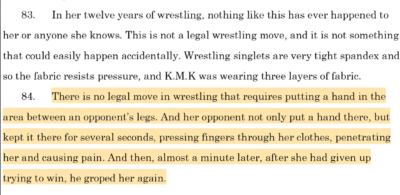
(Her reaction can be seen on video)
If a policy tells girls they must share contact sports with males, then that policy OWES girls a serious protection plan. That is their right to have that.
They don’t get to say, “We performed our interpretation of “inclusion”; our job is done. Good luck, girls.”
It cannot say, “You must accept this,” and then, when harm is reported, suddenly whisper, “Well, this is complicated.”
That is institutional failure.
Girls are being asked to be kind, inclusive, mature, flexible, and quiet. Then when one of them says, “I was harmed,” the room fills with technical language. Adults start reaching for policies, standards, delays, definitions, public-relations statements, and legal caution. (Now where have we heard all of this before?)
When a girl says, “I was violated,” and the adult system answers mainly with procedure, doubt, delay, or technicalities, the public message becomes dangerous: girls may have rights on paper but little power in the room. But where was all that caution before her body became the place where the policy was tested?
The documented reality is grim: most sexual assaults are never reported to law enforcement, and even reported cases often do not lead to arrest or conviction. RAINN reports that only about 310 out of every 1,000 sexual assaults are reported to police.
The CDC also found that in 2023, female students experienced more violence than male students, including sexual violence and school safety concerns.
A serious policy answers the hard questions before harm happens.
What happens when a girl reports unwanted sexual contact?
What happens when privacy is violated?
What happens when intimidation enters the locker room, the bathroom, the team, the mat, the field, or the classroom?
Who protects the girl?
What are the consequences?
What choices does she have without being punished, shamed, isolated, or called hateful?
This is the part too many institutions want to skip.
They want girls to absorb the risk, manage the discomfort, hold their tongues, and trust the process. But the process often becomes very delicate when it is time to protect girls.
That is the old story wearing new clothes.
Historically, girls have been told to be nice before they are told to be safe. They are told to think about everyone else’s feelings before anyone thinks about their fear. They are told to make room, move over, understand, adjust, and be careful how they speak.
Then when something happens, people act shocked that girls no longer trust the room.
A criminal court may say there is not enough evidence to prove a charge beyond a reasonable doubt. That is a legal standard.
But school safety cannot begin and end with what a prosecutor can prove in court.
Schools, athletic associations, and public institutions have a duty to prevent foreseeable harm. They have a duty to protect students. They have a duty to create clear boundaries before harm happens, not just explain their helplessness afterward.
If an institution cannot meaningfully protect girls after an assault allegation, why is it so confident requiring girls to carry the risk beforehand?
Girls unshielded: an Arlington judge threw out indictments against Richard Cox in early June 2026, ruling that the Virginia law used for some of the charges was “void for vagueness” under the Fourteenth Amendment. Cox had been charged after allegedly exposing himself in women’s/girls’ locker rooms at Arlington schools and a fitness center.
The broader case: Cox is a registered Tier III sex offender. Reporting says he repeatedly accessed women’s locker rooms in Northern Virginia facilities, including school-related spaces, and women and girls reported seeing him naked or exposed. Arlington later arrested him, while Fairfax County faced criticism for earlier handling of complaints.
Arlington judge throws out indictments against sex offender Richard Cox
Virginia sex offender accused of entering school and gym locker rooms often – The Washington Post
That is the question.
And it deserves an answer.
Institutions are allowing access first; then families must deal with the consequences. Afterward comes the legal language, the policy explanations, and the “we’re reviewing procedures” posture.
No inclusion policy should require girls to surrender privacy, bodily boundaries, fair competition, or the right to say, “I do not feel safe.”
No girl should be forced to become the test case for an adult theory.
No girl should be told her fear of males in close physical contact with her is “bigotry.”
No girl should be expected to smile through a policy that leaves her unprotected.
Inclusion without enforceable protection is abandonment dressed up in nice language.
And girls deserve better than abandonment. Many will NOT protect girls. Make sure that you do.
Posted on 2/10/ 26
“Views”, “clicks” “followers” nor anything of the sort has been our priority. None of those are our north star here. We are not posting this for sensationalism but to remind parents. Institutions like schools are mandated reporters of sexual assault and sexual abuse. Institutions are run by human beings and as such they may make mistakes.
You do not have to wait for them to make a
- police report
- go to the media
- go to a parent’s groups
- seek the advice of an attorney
Glad that this story is being brought to light where adults who are concerned about the safety and well being of all children can give it the attention that it calls for. Thanks to @BrandiKruse on X.com for being on the side of girls.
What difference does it make?
It’s just one
It’s just a few?
This should NOT be okay with you. This is a potential sexual assault where there were adults in the room.
Speak Up for Black Girls: Protect Her Childhood, Privacy, and Dignity – Rosa’s Children
Boundary Blur Bingo: How Adults Teach Girls to Doubt Their Safety – Rosa’s Children
Podcast Episode: The Fable of the Little Bell at Carver School – Rosa’s Children
Predators Don’t Hide Well—We’re Just Trained Not to Say Anything – Rosa’s Children