Every now and then, I have to pause and ask myself a simple question: Does what I’m being told line up with what I know about human behavior — across
Every now and then, I have to pause and ask myself a simple question:
Does what I’m being told line up with what I know about human behavior — across history, across families, across communities, across lifetimes?
Because lately, in some parts of the conversation about safety, dignity, and spaces, it almost feels like I’m being asked to believe:
“Girls aren’t really being harmed anymore. The story has moved on.”
And something in my spirit says:
Wait. No. That doesn’t ring true.
I don’t care which name or institution says it is, something doesn’t seem right. But most importantly of all, who benefits when girls vanish from the conversation? Because it isn’t girls. So, who is it?
Because IF we solved an epidemic that has plagued us since almost the beginning of time, wouldn’t that be the greatest breaking news ever?
What we already know about the world — without anyone “informing” us
We know — because history, research, and lived experience have told us repeatedly — that:
power gets abused
institutions protect themselves
- people protect what they choose to care about

children often stay quiet long into their adulthood years
girls are often taught to make themselves smaller, quieter, softer
adults sometimes look away because truth is uncomfortable
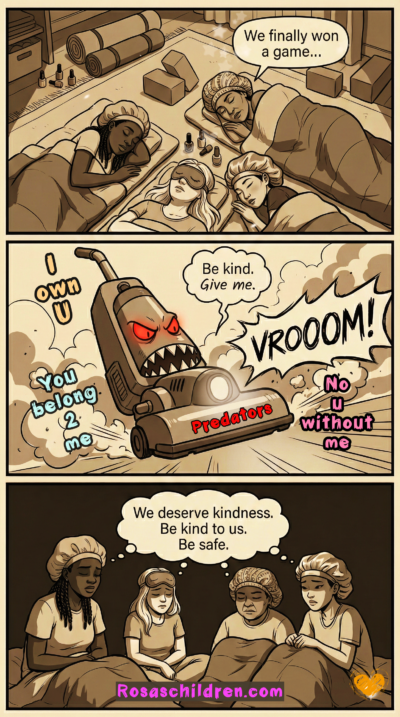
We have seen it in:
families
faith communities
schools
sports teams
youth programs
neighborhoods
workplaces
We have read the stories, watched the documentaries, comforted survivors, sat through court cases, watched the apologies roll out after the damage was done.
Knowing all of that…
Am I really supposed to believe that — suddenly — girls are fine?
That harm packed its bags and went elsewhere?
That the oldest patterns of power simply evaporated?
That girls — who have always been vulnerable to male violence, coercion, grooming, intimidation, and silence — have somehow become “safe now”…
simply because the cultural conversation shifted?
That’s not how human behavior works.
That’s not how power works.
That’s not how trauma works.
When “new” issues enter, the old wounds don’t disappear
Yes — there are new discussions happening.
Yes — different groups are naming their fears and vulnerabilities.
Listening matters.
Compassion matters.
Dignity matters.
But expanding empathy should never require us to forget what we already know to be true:
Not hypothetically. Not symbolically.
In homes.
At school.
At church/faith spaces.
On campus.
At the childcare facility.
In bathrooms.
In locker rooms.
Online.
Anywhere secrecy meets power.
This has never been “old news.”
It is simply news people got tired of hearing.
And when institutions get tired of hearing a truth, they don’t fix it.
They move the spotlight.
Ask yourself — not the internet
Before accepting any neat narrative that quietly erases girls, ask:
Does this line up with what I’ve seen and lived?
Does this match the stories I’ve heard from Survivors?
Does this make sense given what we know about male violence and power?
Who benefits if girls’ harm becomes invisible again?
Whose comfort is protected when girls disappear from the frame?
And the most important question:
With everything I know about human behavior,
do I honestly believe girls aren’t still being harmed?
If the answer inside you is no…
trust that instinct.
It isn’t cynicism.
It’s wisdom, hard-earned.
Refusing to be spoon-fed
We are allowed to think critically.
We are allowed to question when narratives flatten reality.
We are allowed to say:
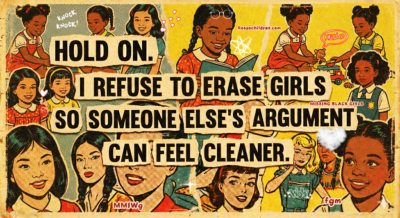
We can care about multiple groups at the same time.
But we should never be expected to sacrifice truth, pattern recognition, and women and girls lived experience just to fit into whatever script is trending.
Girls do not vanish simply because the conversation shifted.
Their safety is not negotiable.
Their vulnerability is not outdated.
Their reality is not disposable.
And we owe it to them — and to ourselves — to remember that.
*As I write this today, there is a feature on one of the social media apps allowing an AI app to disrobe people’s pictures. Take a wild guess who is being targeted.