There is a quiet pressure placed on parents. Be agreeable.Be trusting.Don’t “make things difficult.” And when you don’t go along? They may call you
There is a quiet pressure placed on parents.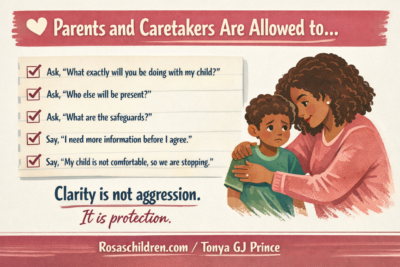
Be agreeable.
Be trusting.
Don’t “make things difficult.”
And when you don’t go along?
They may call you “overprotective.”
“Paranoid.”
“A problem.”
But let’s tell the truth.
Those labels are not random.
They are part of a pattern.
Stereotypes Are a Tool—Not Just an Opinion
Manipulators—whether individuals or systems—often rely on predictable scripts:
The parent who asks questions becomes “the difficult one”
The child who speaks up becomes “confused” or “dramatic”
The adult who pauses the process becomes “uncooperative”
This is not new.
It is a well-worn playbook.
Because if they can make you doubt yourself,
they don’t have to answer your questions.
We Have Seen This Before
Across history and across systems, we’ve seen moments where:
Professionals were trusted without question
Warning signs were minimized
People who spoke up were dismissed
And harm was allowed to grow quietly.
Not because no one cared.
But because no one challenged the authority early enough.
What Ties These Situations Together
This isn’t about a few “bad individuals.”
It’s about patterns that repeat when power goes unchecked:
Authority without accountability
Dependency mistaken for care
Silence from surrounding systems
Status protecting behavior
Children and families not being believed
If we don’t name these patterns, we miss them when they show up again.
Parents: You Are Allowed to Be Clear
You are allowed to:
Ask, “What exactly will you be doing with my child?”
Ask, “Who else will be present?”
Ask, “What are the safeguards?”
Say, “I need more information before I agree.”
Say, “My child is not comfortable, so we are stopping.”
Clarity is not aggression.
It is protection.
Let’s Talk About Standards (Because This Matters)
When we say we want the same type of care for all children, we are talking about standards.
Standards mean:
The same level of safety, no matter the child’s race, income, ability, or background
The same respect for a child’s voice and discomfort
The same requirement for transparency from adults in power
The same consequences when boundaries are crossed
Standards remove guesswork.
Standards remove favoritism.
Standards remove the idea that some children must endure more than others.
A child should not have to be “believed enough,” “important enough,” or “well-behaved enough” to be protected.
Protection should be the baseline.
The Questions That Keep Children Safe
Instead of stopping at outrage, we go deeper:
Where is care quietly becoming control?
Where is expertise being used to shut down questions?
Who is being dismissed instead of protected?
These questions are not disruptive.
They are preventative.
A Truth We Cannot Afford to Forget
Harm rarely begins as something obvious.
It often begins as:
“Just trust me”
“This is normal”
“You’re overthinking it”
And over time, trust goes unquestioned.
That is where harm grows.
A Grounded Reminder for Every Parent
You are not the problem for asking questions.
You are not the problem for slowing things down.
You are not the problem for choosing your child over someone else’s comfort.
You are doing your job.
And your child deserves a world where:
Care never requires silence.
Authority always answers questions.
And protection is not negotiable.