Some books about Black history begin with what was done to Black people. Do You Know Them? Families Lost and Found After the Civil War begins with how
Some books about Black history begin with what was done to Black people. Do You Know Them? Families Lost and Found After the Civil War begins with how deeply Black people loved one another.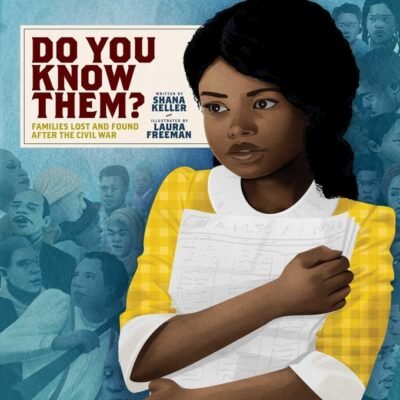
Written by Shana Keller and illustrated by Laura Freeman, this 40-page historical-fiction picture book follows Lettie, a young Black girl living after the Civil War. Slavery has ended, but freedom has not magically repaired what slavery tore apart. Lettie is separated from members of her family who had been sold away, and she wants to find them.
That premise alone may make some parents and teachers hesitate. That’s understandable. A book about slavery, children and separated families can go in many directions, and adults deserve to know what is waiting on the pages before placing a book in a child’s hands.
So, how far does Do You Know Them? go?
The Quick Parent & Teacher Guide
Recommended age: The publisher and Publishers Weekly recommend the book for ages 4–8. TeachingBooks places it in the PK–2 range and gives it an ATOS reading level of 3.6. I would add an important distinction: a child being technically old enough for a book is not always the same as being emotionally ready for its subject. For younger children especially, I would choose this as a read-together book rather than simply handing it over.
Length: 40 pages.
Type: Historical fiction inspired by real history.
Major themes: Family separation, slavery, emancipation, Reconstruction, literacy, Black churches and communities, perseverance, hope, family love and reunification.
What parents should know: The central historical reality is painful. Lettie’s relatives were sold away from her during slavery. Children will encounter the idea that enslaved Black families could be forcibly separated and that, after emancipation, many people did not know where their mothers, fathers, children, siblings and other relatives were.
However, this is not a graphic depiction of slavery. The story’s focus is not beatings, sexual violence or visually frightening scenes of brutality. The emotional weight comes primarily from separation, missing loved ones and wondering whether family members can ever be found.
That difference is important.
What Actually Happens?
After the Civil War, Lettie reads newspaper advertisements aloud to her church congregation. These are notices from formerly enslaved people searching for relatives from whom they had been separated.
Soon, Lettie begins saving the money she earns from sewing and sweeping. She isn’t saving for toys or treats. She wants the 50 cents needed to place her own advertisement in the Richmond Planet and search for her family.
There is waiting. There is uncertainty. There is sadness.
But there is also hope.
The story ultimately moves toward connection rather than leaving a young reader sitting only with loss. Publishers Weekly describes an eventual reply for Lettie and Uncle Charlie, and the publisher describes the book as both moving and triumphant.
For children who are particularly sensitive to stories about losing parents or becoming separated from family, adults may still want to preview the book first.
One Detail Makes This Book Extraordinary
Lettie is fictional.
The advertisements are not.
The family-search advertisements incorporated into the story come from actual historical advertisements placed by African Americans looking for missing relatives. Keller explains this distinction in the book’s back matter.
That changes the conversation.
Children aren’t simply learning that slavery separated families. They are discovering what Black people did afterward.
They searched.
People placed advertisements. They remembered names. They remembered mothers and brothers and daughters. They asked other Black communities for help. They read notices aloud. They kept looking.
For me, that may be the most important doorway this book opens.
There is a terrible historical lesson here, certainly. Human beings were sold away from people who loved them.
But there is another historical truth standing right beside it:
Being separated did not mean people stopped belonging to one another.
Questions Children May Ask
Be prepared for a child to ask, “Why did they sell her family?”
You don’t need to explain every horror of American slavery to a five-year-old in that moment. You can tell the truth in language a young child can carry:
During slavery, Black people were treated as if they could belong to other people. Families could be forced apart and were not allowed to make many of the choices families should be able to make for themselves. That was wrong.
A child may also ask whether this really happened.
The answer is yes.
A useful next step for older elementary children is to explain that historians can still read advertisements placed by formerly enslaved people searching for relatives. The book therefore offers an unusually natural introduction to primary sources: evidence created by people living through history rather than something written about them generations later.
Why I Would Read This With Children
There are ways of teaching Black history that accidentally leave children believing Black people simply endured one terrible thing after another.
This book gives us another way in. Lettie acts.
She works. She saves. She reads. She participates in her community. She searches. The adults around her participate too. Literacy becomes useful. The church becomes a place where information travels. A Black newspaper becomes part of a network connecting people.
School Library Journal specifically praised these layers, noting the book’s attention to hard work, sacrifice, literacy, and community in the effort to reunite families after slavery.
That gives teachers several directions to travel after reading: Reconstruction, Black newspapers, genealogy, literacy, churches as community institutions, primary-source research, and the extraordinary efforts formerly enslaved people made to rebuild family networks.
There is even an official discussion guide available through the publisher, making this especially useful for classrooms, homeschool families, libraries and children’s book groups.
The Rosa’s Children Take
I would recommend Do You Know Them?, particularly as a shared reading experience.
It does not pretend that freedom instantly repaired the damage slavery caused. Children encounter something painful and true: families loved one another and were still deliberately torn apart.
But the book refuses to leave Black families frozen at the moment someone harmed them.
We get to see what happened next.
They remembered.
They searched.
They called people’s names.
They asked, Do you know them?
And sometimes, across miles and years and all that had been deliberately placed between them, somebody did.
That is Black history too.
Official publisher page and educator resources for Do You Know Them?